




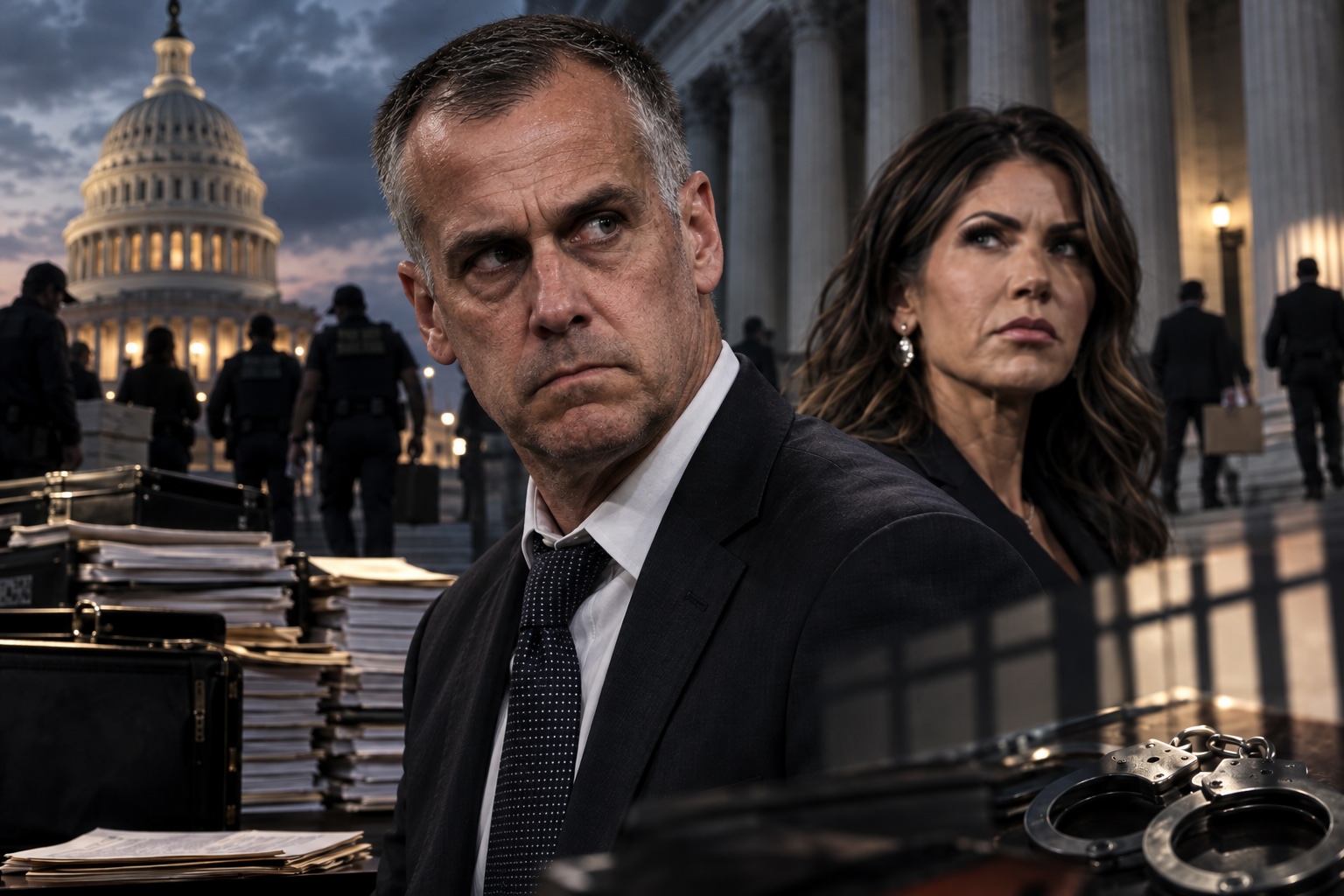
The Justice Department is reportedly looking into allegations that conman Corey Lewandowski profited off his top position at the Department of Homeland Security under Kristi Noem, people familiar with the matter said.
The inquiry is based on a referral from the DHS inspector general, which shared its findings about Lewandowski’s time at the department in recent days.
Lewandowski served as the top adviser to then-Homeland Security Secretary Kristi Noem up until the pair were ousted from the department in March, following increasingly embarrassing revelations about the infighting at the agency and their spending decisions, as well as their personal relationship.
While at the department, Lewandowski appeared to try to use his vast influence for personal financial gain, including asking several countries in the Middle East to hire him on the side to assist with visa issues and other matters.
He or close associates signed off on nearly all department spending decisions for amounts exceeding $100,000, giving Lewandowski a view into the array of contractors DHS worked with, and the ability to hold the contracts up.
Lewandowski has previously denied seeking foreign contracts while in government or playing any role in approving DHS contracts. People familiar with the inquiry told the Wall Street Journal that it is focused at least in part on contracting fraud.
A representative for Lewandowski asserted that Lewandowski has not been contacted by the Justice Department regarding any investigation. “He denies any wrongdoing when he was proudly serving his country in a voluntary capacity,” the representative said. The DHS inspector general’s office said it doesn’t discuss specific investigative matters or confirm or deny the existence of an investigation.
Investigators with the DHS inspector general’s office found evidence that Lewandowski may have been involved in improperly awarding government contracts, the Journal reported in July. The office, the agency’s internal watchdog, had for months been weighing a criminal referral to the Justice Department.
The current Homeland Security secretary, Markwayne Mullin, has received briefings on the investigation, according to people familiar with the matter.
The investigators looked into many of the contracts the department signed during Noem’s tenure, and department officials had been surprised at how involved Lewandowski was in the contracting process, some of the people said. He personally signed specific contracts, according to people who reviewed those documents or had knowledge of the approvals, despite not technically serving as a full-time U.S. government official.
He was working in an unpaid capacity as a “Special Government Employee,” a designation in federal ethics law meant to bring outside officials with particular expertise into the government on a temporary and part-time basis, without forcing them to relinquish outside work or investments.
Lewandowski served as Trump’s first campaign manager in 2016 and has maintained a close relationship over the years with the president, who valued his loyalty.
Advertisement
Lewandowski has told people close to him he expects the president would pardon him in the event of a criminal case, the Journal previously reported. A lawyer for Lewandowski has said Lewandowski didn’t speak about or suggest that he would seek or need a presidential pardon.
Corey Lewandowski has a long history of criminality and corruption that is disturbing to anybody that truly reads into it.
Lewandowski, who was technically serving as a special government employee, wielded an unprecedented level of influence within the agency, multiple DHS officials told National Review.
Early on in his tenure at DHS, Lewandowski quickly developed a reputation as Noem’s closest adviser. For years, the pair had batted away allegations that they were engaged in a romantic relationship; both are married and have children. So, it came as no surprise that he soon began calling the shots inside the department charged with carrying out Trump’s mass deportation campaign and spending the billions in congressionally appropriated funds dedicated to that purpose.
Lewandowski had broad purview over all decisions made inside DHS, big and small. Inside the building, he became known as “Chief.”
“All written communication and all of the little minions in the front office, all the 23-year-olds who have pledged undying loyalty to Corey, would call him ‘Chief,’” a senior administration official said.
Portions of Noem’s schedule, obtained by National Review, are chock-full of references to her “Chief” Lewandowski, whose title was constantly invoked in schedule notes on high-level decisions or official engagements that were pending approval.
Notes written by staffers show that Noem deferred scheduling choices to Lewandowski. One scheduling note suggests that Noem had opted to decline an invitation to a United Nations event “unless Chief says it is important.”
Even first responder appreciation-day speaking engagements would require Lewandowski’s signoff. In the notes section of a September 5, 2025, scheduling memo, a line specified that the department was leaning against accepting a speaking request for January 6, 2026, for “Law Enforcement and Fire Fighter Appreciation Day” in Florida.
“Probably No – Ask Chief,” the memo reads.
In addition to greenlighting the secretary’s meetings, trips, and special appearances, Lewandowski’s de facto chief of staff status meant he had the final say on approving travel requests for every senior official and final say on who attended high-level DHS meetings.
“I don’t think she ever took meetings without him standing in there,” a senior administration official recalled. “I was supposed to have a one-on-one meeting with her, and he was in there. He took meetings without her, but she never took meetings without him.”
A Long History
Lewandowski’s control over Noem’s schedule predates her time as DHS secretary. One incident from 2022, when Noem was running for reelection as South Dakota governor and Lewandowski was advising her, suggests that he has long been comfortable using Noem’s public stature to manipulate people, even political allies.
In April 2022, the pair traveled to Washington State where Noem was scheduled to headline political events for multiple Washington Republicans, including Fifth District Congresswoman Cathy McMorris Rodgers and Eighth District GOP candidate Jesse Jensen. Lewandowski, whom Noem had hired to help with her campaign, was in tow.
The day before a scheduled fundraiser breakfast with Jensen’s congressional campaign, Lewandowski approached one of Jensen’s campaign aides and said Noem’s team was thinking of taking an early plane home, according to two sources familiar with the matter.
Confused and frustrated that the governor’s team would cancel at the last minute, Jensen’s aide called a Lewandowski staffer to reiterate the importance of Noem showing up on time and in person to an event that people had traveled across the state to attend.
Later that day, the play became clear: Lewandowski was threatening to book Noem on the next flight home if Jensen’s campaign didn’t immediately cough up $25,000 in contributions to Noem, the sources said.
“I’ll give Corey credit: announcements had gone out, people were traveling across the state to come have breakfast with the governor, everything was set in stone, and he pulled this thing the night before at the afternoon funder and said, ‘I’ll get her on an earlier flight if you don’t get me the 25k,’” a source familiar with the incident told National Review.’
“It was just clear as day that they’d done this before,” the person added.
Lewandowski Dominates at DHS
Once Noem took over at DHS, with Lewandowski by her side, the longtime Trump ally began to use his position to contact powerful people in the private sector for purposes that were never made clear to many senior department officials, multiple DHS staffers told NR.
Lewandowski regularly ran meetings with private sector companies and would constantly pester senior leaders inside DHS to track down CEOs’ cellphone numbers, fomenting suspicions within DHS that he was using his connections to private sector interests for personal gain.
“His team would call private sector companies, always under the guise that the ‘secretary’ would be the one calling, the ‘secretary’ needed the information. The ‘secretary’ needed a meeting,” a senior administration official recalled. “It was never the secretary, it was always Corey.”
Lewandowski also took steps to conceal the extent of his involvement at DHS. Federal law prohibits special government employees from working more than 130 days per year. Lewandowski would regularly walk into the building with other staffers to avoid swiping in and creating a record of his presence in the building, sources familiar with the matter say. He regularly had aides call people, only for him to yell in the background so he could personally chew them out. DHS staffers have long suspected this is because he wanted to avoid logging phone calls in any official capacity.
Lewandowski ruled with an iron fist. According to sources inside the building, he constantly threatened to fire, demote, polygraph, or reassign people who got on his bad side. Career staffers have long been terrified of losing their retirement benefits or being blacklisted from DHS contracts if they leave for the private sector.
The investigations on Capitol Hill into allegations of self-dealing by Lewandowski are just getting started, and multiple media outlets — and now the State of Minnesota under Governor Tim Walz — have joined in.
This week alone, the muddy picture surrounding the DHS contracting process has become a bit clearer. New reporting in the Daily Wire, ProPublica, Bloomberg, and NBC News shows that during her congressional hearings this week, Noem misrepresented the competitive nature of the $220 million ad contract that benefited her political allies, and that the agency invoked an emergency exception to circumvent the competitive bidding process that typically governs how contracts are approved.
While the public is just now catching up, DHS officials have long suspected that Lewandowski and his closest aides were steering contracts to their allies.
“The fraud examiner in me believes that it is a high probability that somebody in the department is getting kickbacks because of what I’ve seen contractually,” one senior DHS official told National Review, although the official had no direct knowledge of any wrongdoing.
In normal contractual processes, “if you have a good, solid vendor, doesn’t matter who they are,” the senior DHS official said. And yet Lewandowski and his team “only seem to care about the vendors, not necessarily the business that we’re doing, but more what vendor are we doing business with.”
Noem and Lewandowski Rise and Fall Together
It’s unclear where Lewandowski, who has survived multiple falls from grace within Republican politics in recent years, will land after Noem’s ouster (Trump announced that the outgoing DHS secretary will be reassigned as “Special Envoy for The Shield of the Americas,” a security initiative). Multiple outlets have reported that he’s been dismissed as a special government employee, but DHS has not publicly confirmed the news.
After the former Trump 2016 campaign manager fell out of favor with the president’s inner circle years ago, Lewandowski used his ties to Noem to reclaim power and influence inside the highest levels of government.
In 2020, he shepherded her through his home state of New Hampshire for her puzzling campaign stop in the first-in-the-nation primary state during her gubernatorial reelection campaign. Throughout the campaign, he developed a reputation for using the same tactics he’d later employ at DHS, berating subordinates for any perceived failures, a source who witnessed the behavior told NR.
His personal relationship with Noem then helped him work his way back into Trump’s orbit and secure a role with the Republican National Convention, which National Review first reported in May 2024.
Lewandowski’s work for Noem continued into the 2024 campaign cycle, when Noem was privately gunning to serve as Trump’s vice president. The nature of their professional and allegedly romantic relationship was a constant source of confusion and conversation for campaign staff.
For example, Lewandowski attended her trip to Michigan for the state party convention in August 2024, people who saw them there together said. At one point after the RNC convention, Lewandowski brought Noem into the Trump campaign’s West Palm Beach headquarters and introduced her to staff for no apparent reason, puzzling campaign hands who were just trying to get through a day’s work, according to people who were in the building that day.
When Noem’s national political ambitions reached a low point during her ill-fated book tour, Lewandowski remained by her side.
In April 2024, Lewandowski defended Noem on a media campaign to promote her memoir, No Going Back. Ahead of an interview with Fox Business host Stuart Varney, Lewandowski insisted that Varney refrain from asking her about the more controversial storylines surrounding her newly released book, including her description of shooting and killing her 14-month-old dog, Cricket, 20 years prior.
Noem’s frustration was evident onscreen as she struggled to stay above water in one of the most contentious interviews of her book tour.
“Enough, Stuart. This interview is ridiculous, which you are doing right now,” Noem said at one point in the interview. “So, you need to stop. It is okay. It is. Let’s talk about some real topics that Americans care about.”
At one point during Noem’s interview, a source familiar with the matter recalled to National Review, Lewandowski grew so exasperated off set with Varney’s Cricket-focused line of questioning that he started yelling at the television. Corey Lewandoswki belongs behind bars.